| 22.3.99 | 23.3.99 | |
| 9.3.99 | 3.3.99 | 21.2.99 |
| 15.2.99 | 12.2.99 | 3.2.99 |
| 31.1.99 | 29.1.99 | 18.1.99 |
| 9.12.98 | 3.12.98 | 22.11.98 |
| 24.9.98 | 21.9.98 | 16.9.98 |
A week from now the premiere will have been and gone! I've nothing very specific to say in this diary entry, other than to record that I have all the usual mix of feelings of apprehension, excitement, self-doubt, self-confidence and anticipation that goes along with premieres. At the rehearsal the other day, some members of the orchestra made some very nice remarks about the piece, saying how well-written and clear it is. I am delighted with that, because it is one of my goals in this project to communicate clearly and effectively with the audience. In a week's time, I'll find out whether or not I've achieved that!
First orchestral rehearsal.
A very interesting and enjoyable occasion. I think the piece is going to work just fine!
We were able to rehearse Movements 2 and 3 completely (with tape for Movt. 2), and the orchestral material for Movement 1 (with amplified double bass). The live MIDI soundfiles for Movement 1 will have to be added at the Hall on May 27th, because we did not have the appropriate technical set-up in the rehearsal venue (St Johns Church, Boscombe).
Movement 3 was rehearsed first and went very well. There were a few balance questions (between string and wind) which will be resolved by suitable mixing since the orchestra is to be amplified. It was hard to judge the extent of the imbalances because the church is so resonant. Most of the rehearsal focussed upon questions of rhythm (getting the right feel) and articulation (how the notes are played). The players settled into this quickly and I'm pretty certain this movement will make an immediate and lively impact.
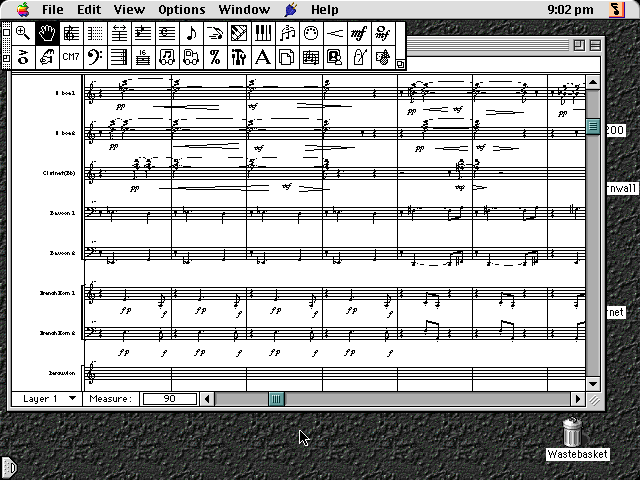
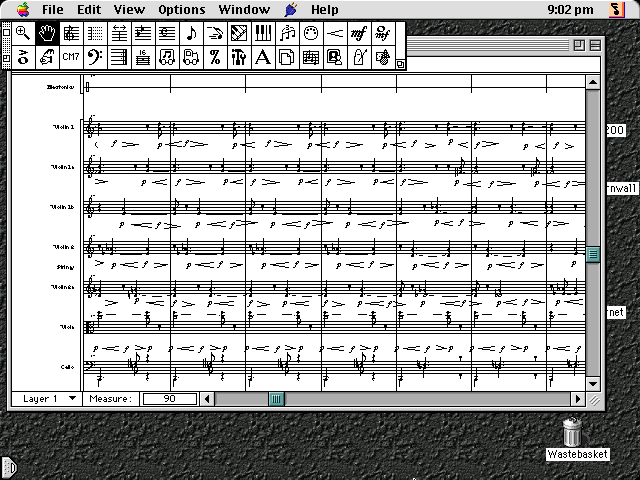
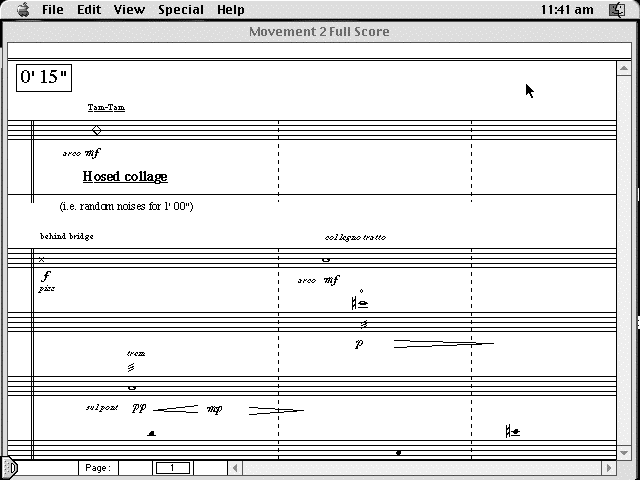
Movement 2 took some explaining: many of the players had not seen notation like this before. Richard Studt (the conductor) decided to beat 5 beats per "bar", at a pulse of 60 beats per minute - in other words he became a ticking clock against which the players could time their entries depending upon whereabouts the notes were placed within the bar (see previous diary entry for a more detailed explanation of this).
A couple of notational problems also arose during the "gamelan" section. In attempting to imitate the sound of Javanese string and wind instruments, I had written extremely high and fast material for a solo violin, and also some very high oboe notes. Classical players are used to playing exactly what's in front of them, and what I wrote looked more or less unplayable without years of practice! I had to explain that in both cases I was after an effect rather than detailed accuracy - a modal meandering around the tune. In gamelan music, the higher up you go in register the more rapidly the instruments are played, but these are not more prominent than the rest - in fact, the most prominent thing is the slow-moving tune. Anyway, once I'd explained what I wanted to the players they got it just fine and the results sounded very good. I think I will try to find a different way of notating this passage.
The section immediately after the gamelan was the most enjoyable surprise, sounding much richer and fuller than I'd expected. The addition of the flanged electric guitar sounds filled out the texture beautifully and a genuine "tutti" was felt - something which is normally difficult with only 24 players. This was the only part of the Symphony which did not sound exactly as I'd imagined it, and the result was an improvement on what I'd imagined so I was very happy.
Overall, the best thing about the Movement 2 rehearsal was that they played it through once and it all worked! When asked to comment, I suggested that the string players in particular (who make lots of unusual noises) 'theatricalise' their gestures. Live music is a visual as well as an auditory experience and the more the players can give out to the audience, the more likely it is that the audience will be drawn into the piece.
The rehearsal for Movement 1 was necessarily rather patchy, given the absence of the live MIDI, and it will be this movement that requires the most attention on May 27th. The difficulty is making things flow, since there are numerous changes of mood and tempo. The orchestra seemed to experience the most problems with rhythmic layering - pulses moving at different speeds simultaneously. Nevertheless, things were basically pretty good and I'm confident it will all come together. I was also very impressed by the commitment and skill shown by the two featured players: Howard Nelson (flutes) and Keith Wood (amplified double bass). Keith had to work with some effects pedals which changed his sound quite a bit, and we had some interesting technical discussions about these. Howard plays all the flutes: piccolo, flute, alto flute, and bass flute! This meant a change in embouchure (mouth position) throughout the Movement - a virtuosic thing in itself - but his duet with Keith at the end of Movement, playing the mighty bass flute, promises to be the highlight of the whole Symphony.
My approach in the rehearsal was (as it always is) to try to be as flexible as possible, and to take on board suggestions and comments from the players. I'm a pragmatist - I want to achieve something which 'works' and I'm quite happy to drop or modify my ideas to do so. When composing, I'm always exploring and experimenting, trying to create new sound images and textures. Sometimes that leads me into conflict with established practice, or indeed simple playability. By and large this has not been a problem in 'Symphony for Cornwall', especially because the soundfiles are so interesting in themselves, but on the occasions where problems do arise I feel it is my responsibility to ensure that the players are happy and that the material communicates itself well to the band.
Movement 2 finished.
You know, it's mighty difficult to describe the creative process as it is actually happening, especially when there is a deadline looming (in this case, all the scores and parts have to be ready by March 31st). Movement 2 has been more difficult to do than the other two Movements - indeed, I have actually "trashed" two minutes' worth of music from this Movement, which added to the pressure to get the piece done in time. So here is an attempt to summarise the process for Movement 2, written with the awareness that I am probably making some tasteful edits to remove the hair-tearing moments!
Just to recap, I'd decided that the Movement would use the "noise"-based soundfiles and all the guitar samples, and that it would be scored for orchestra and tape (which plays continuously) and that it would last ten minutes. All these decisions have been seen through to the end.
The soundfiles used are, therefore:
The Green Theme (all the various sounds) from Roseland Community School Callington School's PPwav Ed Weston's guitar and jungle files (Penrice School) Humphrey Davy School's noise collage Looe Community School's guitar tracks Torpoint's flanged and twangy guitars I also added to this the sounds of Looe's glockenspiels, and the improvised oboe and bass clarinet duet recorded by members of the Bournemouth Sinfonietta.This last piece is in A minor, as is a great deal of the guitar material and a number of the soundfiles that appear in other movements ('Relax.wav, David Allsop's tune, etc. etc.) Perhaps I should say the Aeolian mode, because almost everybody seems to favour the flattened leading note - that is to say the scale A-B-C-D-E-F-G-A (white notes on the piano) in preference to the more "classical" A-B-C-D-E-F-G sharp-A. This curious coincidence gives the basic modality for this Movement, although at least half the material is noise and therefore not pitched.
The "recycling" idea, favoured by Roseland, is another theme here, and material is processed in a number of different ways, including a central evocation of the Javanese gamelan (metal percussion orchestra) using the Looe glockenspiels - sampled and played back as a Midi sequence - to conjure up the soundworld, and the notes of the Oboe/Bass Cl. duet as the "balungan" or skeleton melody.
The duet, which has a pastoral feel, also led to the section which I eventually threw away - a kind of dark pastoral meditation, drifting and fairly complex. This material simply would not fit anywhere with everything else, and so had to go. Gardening is a ruthless business and growing a Symphony is no exception! Perhaps what I wrote will re-surface somewhere else one day.
Anyway, the piece runs as follows . Timings given in minutes and seconds.
0' 00"-0' 15" Humphry Davy School's noise collage 0' 15"-1' 15" Hosed collage (i.e. filtered through all kinds of processes, to produce a scattered "random" feel) accompanied by strings and tam-tam 1' 15"-1' 25" GT (= Roseland's "Green Theme") plastic bottles 1' 25"-1' 40" Noise collage derived from processes applied to soundfiles, accompanied by wind players breathing silently through instruments 1' 40"-2' 15" Wind breaths continue, mixed with GT elements. Strings add in and a climax is reached with the glass smash, which immediately reverses 2' 15"-3' 00" Ed Weston's "jungle" rhythm track, but slowed down, with rhythms, sounds and events scattered almost randomly across the stereo image, accompanied by more structured orchestral effects 3' 00"-3'50" The GT noises are combined with the Oboe/Bass Clarinet duet. Romantic, bleak atmosphere 3'50"-6'00" Looe glocks enter, playing a gamelan tune and the orchestra joins in for an extended piece. Solo violin, oboes, flute and bass clarinet all play highly elaborate and decorative versions of the melody, all in a kind of Aeolian mode 6'00"-8'15" the final note of the gamelan launches an extended flanged drone, derived from the Torpoint guitars. All kinds of processes applied here, also to Callington's PP.wav. Strings and some wind pick out the upper harmonics, in a slow spectral shift, while the bass clarinet solos, continuing to elaborate the "pastoral" theme from earlier in the movement 8'15" - 8' 35" Solo cello, doubled by violin playing artificial harmonics, plays a short four-bar tune which seems to summarise elements of everything, from all movements. The orchestra repeats an A minor chord, echoing the end of Movement 1. At the end of this section, Ed's guitars mixed with twangs, fade in. 8' 35" - 10' 00" Pure tape composition. The guitars accompany the oboe and bass clarinet duet. Elements of all the soundfiles are edited together, processes applied, and the GT slapping wet leaves end the movement.In the next diary entry, I'll talk about the technical and notational requirements of the above. For now... I'm exhausted!
Back to top