Phaon
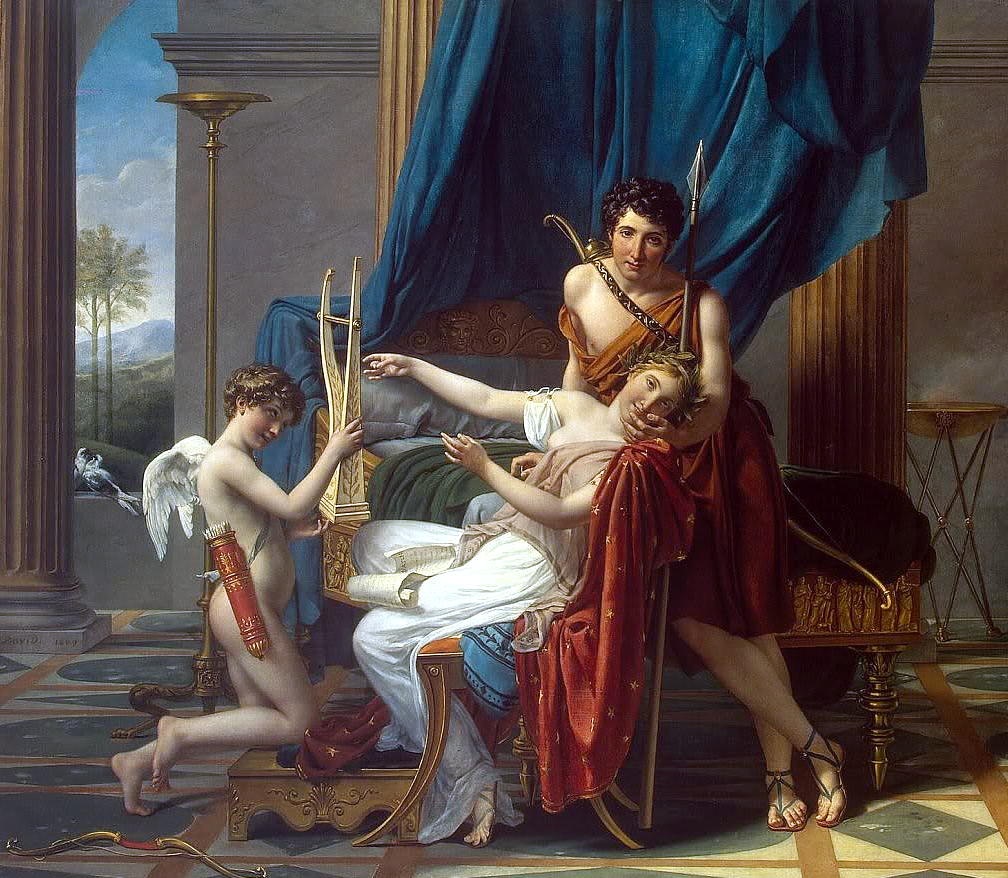
'Sappho, Phaon, and Cupid' by Jacques-Louis David, 1809.
- Ensemble version (George W. Welch · live at BMIC (1984): Listen
- 4 Harmonium version (Andrew Hugill): Listen
Notes
Phaon was composed in February 1982 and scored for four harmoniums and voice. The ensemble version was created for George W. Welch in 1984. Despite using the same notes, there are substantial differences in character between the two versions. Phaon was supposedly a ferryman and an ideal male beauty, with whom the Ancient Greek poet Sappho was in love. As this love was unfulfilled, she threw herself off the Leucadian cliffs, at a place known as Sappho's Leap. This rather preposterous story, which dates back at least to Menander in the 4th Century BCE, was much repeated in the 19th Century in an attempt to counter the truth of Sappho's homosexuality.
I had become fascinated with Sappho's poetry and in particular a fragment which Mary Barnard translates as: "If you're squeamish, don't prod the beach rubble." For me, the "beach rubble" represented things that had become obsolete, but which still carried symbolic value. This included the harmonium, an instrument whose original purpose had long since died, but which still existed in a physical form (I owned six of them at one time).
Among my pieces of beach rubble were the music of Scriabin and Granville Bantock's settings of Helen Bantock's rewritings of Sappho's poetry in the song cycle 'Sappho' (1906). These two sources provide much of the found material for my piece. The first section layers a fragment from 'Prometheus: A Poem of Fire' associated with the note B flat on the colour organ, the colour rose (or steel) and Lust or Passion. For me, it was the synaesthetic elements of Scriabin's music that amounted to beach rubble which I was prodding. The fragments are played simultaneously at different speeds, culminating in a passionate quotation of Sappho's rejection of Phaon: "Thou art nought to me", as set by Granville Bantock. The rest of the composition takes on a more minimalistic quality, as it stretches out patterns to support ever extending Scriabin-derived melodies.Performance notes
The electric guitar in the ensemble version could be replaced by a harmonium, with the tremolo section being played using a tremolo stop.